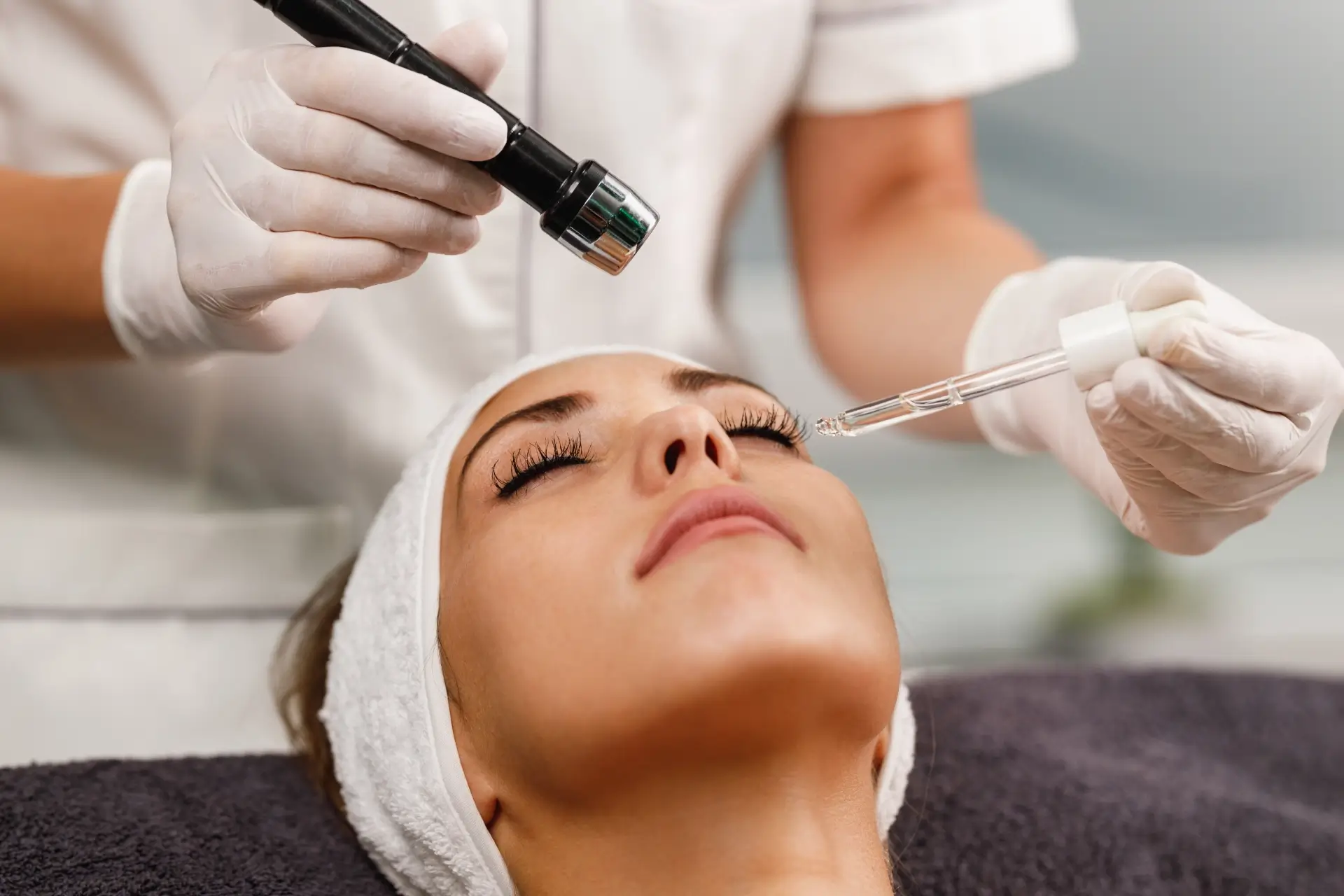
Microneedling and fractional laser resurfacing both trigger new collagen through controlled micro-injury, but with different tools and depth control. Microneedling uses fine mechanical punctures; fractional laser resurfacing — the technology Flawless Derma Centre uses — delivers fractionated thermal energy. Which suits you depends on your skin, your concern, and how much downtime you can accept.
How Does Microneedling Work?
Microneedling uses a device studded with very fine needles — a manual roller, a motorized pen, or a needling handpiece — to create hundreds of tiny mechanical punctures across the treatment area. Each puncture is a controlled micro-injury that triggers your body’s wound-healing response, prompting new collagen and elastin production over the following weeks. Some devices add radiofrequency energy at the needle tip (often called RF microneedling), combining mechanical puncture with a small amount of heat. Because standard microneedling doesn’t rely on light or heat absorption by pigment, it’s generally considered a colour-blind technique. The FDA has noted that certain uses of radiofrequency microneedling carry additional risks worth understanding, including burns and scarring when devices are used improperly (FDA safety communication), which is one reason technique and provider training matter as much as the tool itself.
How Does Fractional Laser Resurfacing Trigger Collagen Renewal?
Fractional laser resurfacing takes a different mechanical approach entirely. Instead of physical punctures, the laser delivers energy in a grid of microscopic thermal columns — treating a fraction of the skin’s surface at a time while leaving the tissue between columns untouched. That untouched tissue acts as a reservoir of healthy cells, which speeds healing compared to treating the entire surface at once. The heat from each column denatures old, disorganized collagen and signals the skin to remodel and rebuild it. At Flawless Derma Centre, treatments are delivered with SharpLight’s medical-grade platform, which allows Priscila Ferreira to adjust depth and intensity to the concern and skin type in front of her, rather than using a single fixed setting for everyone. The FDA’s overview of medical lasers is a useful primer on how these devices are regulated and what they’re intended to treat.
Which Skin Concerns Does Each Approach Suit Best?
Neither treatment is universally “better” — they tend to shine for different concerns:
- Microneedling is often chosen for fine lines, mild texture irregularities, early acne scarring, and improving how well topical products absorb afterward. Its appeal is minimal downtime and a technique that works similarly across skin tones.
- Fractional laser resurfacing is often chosen for sun damage, pigment irregularities, more pronounced texture and acne scarring, and situations where a patient wants adjustable depth in a single session rather than relying purely on repetition.
- Some patients — outside what Flawless Derma Centre offers — pursue a combination approach with their provider, since the two mechanisms address collagen from slightly different angles.
A peer-reviewed split-face trial comparing the two found comparable improvement in facial rejuvenation between microneedling and fractional Er:YAG laser, with microneedling’s shorter downtime making it preferable for some patients in that study (Robati et al., Journal of Cosmetic Dermatology). Results like these vary by study design, device, and skin type, so they’re a helpful reference point rather than a guarantee of any individual outcome.
Microneedling vs. Fractional Laser Resurfacing at a Glance
| Microneedling | Fractional Laser Resurfacing | |
|---|---|---|
| Mechanism | Mechanical punctures from fine needles trigger a wound-healing response | Fractionated thermal energy columns heat targeted tissue, sparing surrounding skin |
| Typical downtime | Minimal — redness for 24–48 hours is common | Several days of redness, and longer for more aggressive settings |
| Typical sessions | Often a series, spaced roughly 4–6 weeks apart | A short series, spaced to allow full healing between visits |
| Best-suited concerns | Fine lines, mild texture, early scarring, product absorption | Sun damage, pigment irregularities, deeper texture and scarring |
| Precision & depth control | Depth is set by needle length; heat is not part of standard devices | Depth and intensity are electronically adjustable to the concern and skin type |
Exact downtime, session counts, and spacing vary by individual skin and the settings used, which is why a consultation — not a generic chart — sets the real plan.
How Much Downtime Should You Expect, and How Many Sessions?
Downtime and session count are two of the most common questions Winnipeg patients ask before committing to either option. Microneedling’s mechanical punctures tend to heal quickly, often leaving skin pink for a day or two, which is why it’s popular with people who can’t take time away from work or family life. Fractional laser resurfacing, because it introduces controlled heat as well as micro-injury, typically involves more visible redness and some skin flaking for several days, with more aggressive settings requiring longer recovery. Both approaches are usually delivered as a short series rather than a single visit, since collagen remodelling is gradual and builds with each session. At a Flawless Derma Centre consultation, Dr. Kourosh Harandi and Priscila Ferreira map out a realistic number of sessions and spacing based on your skin’s response — never a one-size-fits-all package.
Is One Option Safer for Darker Skin Tones?
Skin tone is one of the most important factors in choosing between these approaches, and it’s a question we take seriously at every consultation. Because standard microneedling is purely mechanical, it doesn’t rely on light absorption by melanin, which is why it’s often considered a comparatively safe option across a wide range of skin tones for post-inflammatory pigment changes. Laser-based treatments carry more variability: the risk depends heavily on the specific wavelength, the device, and the technique used, so outcomes differ from clinic to clinic and device to device. With adjustable, medical-grade platforms like SharpLight and a provider trained to calibrate settings to Fitzpatrick skin type, fractional laser resurfacing can be suited to a broad range of skin tones — but it always requires an individualized assessment rather than a default setting. If you’re curious how skin tone factors into laser treatments generally, our guide to laser treatments and skin tones covers the same underlying principles.
Why Flawless Derma Centre Offers Fractional Laser Resurfacing, Not Microneedling
We want to be upfront about something: Flawless Derma Centre does not offer microneedling. We chose to build our skin rejuvenation offering at our Winnipeg clinic around SharpLight’s fractional laser resurfacing technology because it gives Priscila Ferreira precise, electronically adjustable control over depth and intensity, backed by Dr. Kourosh Harandi’s medical oversight as our Family Doctor and Medical Director. Laser devices used for skin treatments in Canada fall under Health Canada’s radiation-emitting device rules, which classify lasers by hazard level and set requirements for safe, supervised use (the federal Radiation Emitting Devices Act) — one more reason we’ve invested in a medical-grade platform. That doesn’t make fractional laser resurfacing “better” in every case — it means it’s the tool we’ve trained on and can stand behind with confidence. If your goals and skin are a genuinely better match for microneedling, an honest consultation will tell you that plainly rather than steering you toward what we happen to offer. That’s the same approach we take across every service, as described on our about page — no upselling, ever.
How Does a Consultation Decide What’s Right for You?
A good consultation is what turns a general comparison like this one into an actual plan. At Flawless Derma Centre, that process typically includes:
- A skin assessment, including your Fitzpatrick skin type, current concerns, and treatment history.
- An honest conversation about what fractional laser resurfacing can realistically achieve for your specific goals — and when it isn’t the right fit.
- A transparent plan, with session count, spacing, and pricing confirmed before you commit, referenced against our published pricing.
- Aftercare guidance tailored to your skin’s healing response, since downtime varies person to person.
Whether you’re coming from River Heights, St. James, Tuxedo, Charleswood, or anywhere else around Winnipeg, the process is the same: an honest look at your skin before any treatment is booked.
Making the Choice With Confidence
Choosing between microneedling and fractional laser resurfacing isn’t about picking the trendier option — it’s about matching the mechanism to your skin and your concern. If a consultation shows fractional laser resurfacing is the right fit, Flawless Derma Centre’s SharpLight-based treatments, delivered by a Certified SharpLight Practitioner under physician oversight, are ready to help. If your goals point elsewhere, we’ll say so. Winnipeg patients from Wolseley to Headingley have come to expect that kind of directness, and it’s not changing.
Curious whether fractional laser resurfacing fits your skin? Book a consultation or review current pricing to see what an honest, physician-led plan looks like for you.
You can also see how this treatment works at our clinic on our skin rejuvenation in Winnipeg page.