Most acne scars improve with a staged approach: first calm active acne, then address remaining texture with treatments like fractional laser resurfacing, which stimulates the skin’s own collagen over a series of sessions. Full erasure isn’t realistic for most textural scarring, but many people see meaningful, lasting improvement in smoothness and tone.
What’s the difference between active acne, marks, and true scars?
Not every mark left behind by a breakout is a scar. Active acne refers to the pimples, cysts, and inflammation currently on your skin. Once a blemish heals, it often leaves behind a flat red, purple, or brown mark called post-inflammatory hyperpigmentation — this is discolouration, not damage to the skin’s structure, and it typically fades on its own over weeks to months, especially with diligent sun protection. True acne scarring is different: it’s a change in the skin’s texture, caused by disrupted collagen during the healing process, showing up as indentations (atrophic scars) or, less often, raised, thickened tissue (hypertrophic scars). Marks fade with time and sun avoidance; textural scars generally don’t resolve without some form of professional treatment. Telling these apart matters because chasing an in-clinic laser for a mark that would have faded on its own is a needless expense — an honest assessment starts with an accurate diagnosis of what you’re actually seeing in the mirror.
What are the main types of acne scars?
Dermatology research classifies most textural acne scarring into a handful of recognizable patterns, each shaped by how the original breakout damaged the skin (PMC, National Institutes of Health). Knowing which type — or combination of types — you’re dealing with is the starting point for any honest treatment conversation.
| Scar type | What it typically looks like | What tends to help |
|---|---|---|
| Ice pick | Narrow, deep, sharply defined pits | Often needs a combined approach; deep pits respond less predictably to laser alone |
| Boxcar | Round-to-oval depressions with sharp, defined edges | Often responds well to fractional resurfacing, especially when shallow |
| Rolling | Broad, undulating depressions with soft, sloping edges | Tends to respond well to fractional resurfacing, which softens the tethering beneath the surface |
| Hypertrophic | Raised, firm, thickened tissue at the scar site | A different mechanism than atrophic scarring; assessed individually at consultation |
Most people have more than one pattern at once, which is normal — it’s part of why a personalized assessment matters more than a generic treatment plan.
Why treating active acne always comes first
It’s tempting to want scarring addressed immediately, but resurfacing skin that still has active breakouts tends to backfire: inflammation can worsen, healing is less predictable, and new marks or scars can form during the process. Canadian dermatology guidance describes a tiered approach to acne itself, starting with topical options and escalating as needed under professional guidance (Canadian Dermatology Association). At Flawless Derma Centre, we follow the same logic with scarring: active acne is brought under control — often through our acne treatment program, outlined further in our adult acne guide — before we plan any resurfacing. It’s a slower path than jumping straight to laser, but it protects your results and your skin.
How does fractional laser resurfacing treat textural scarring?
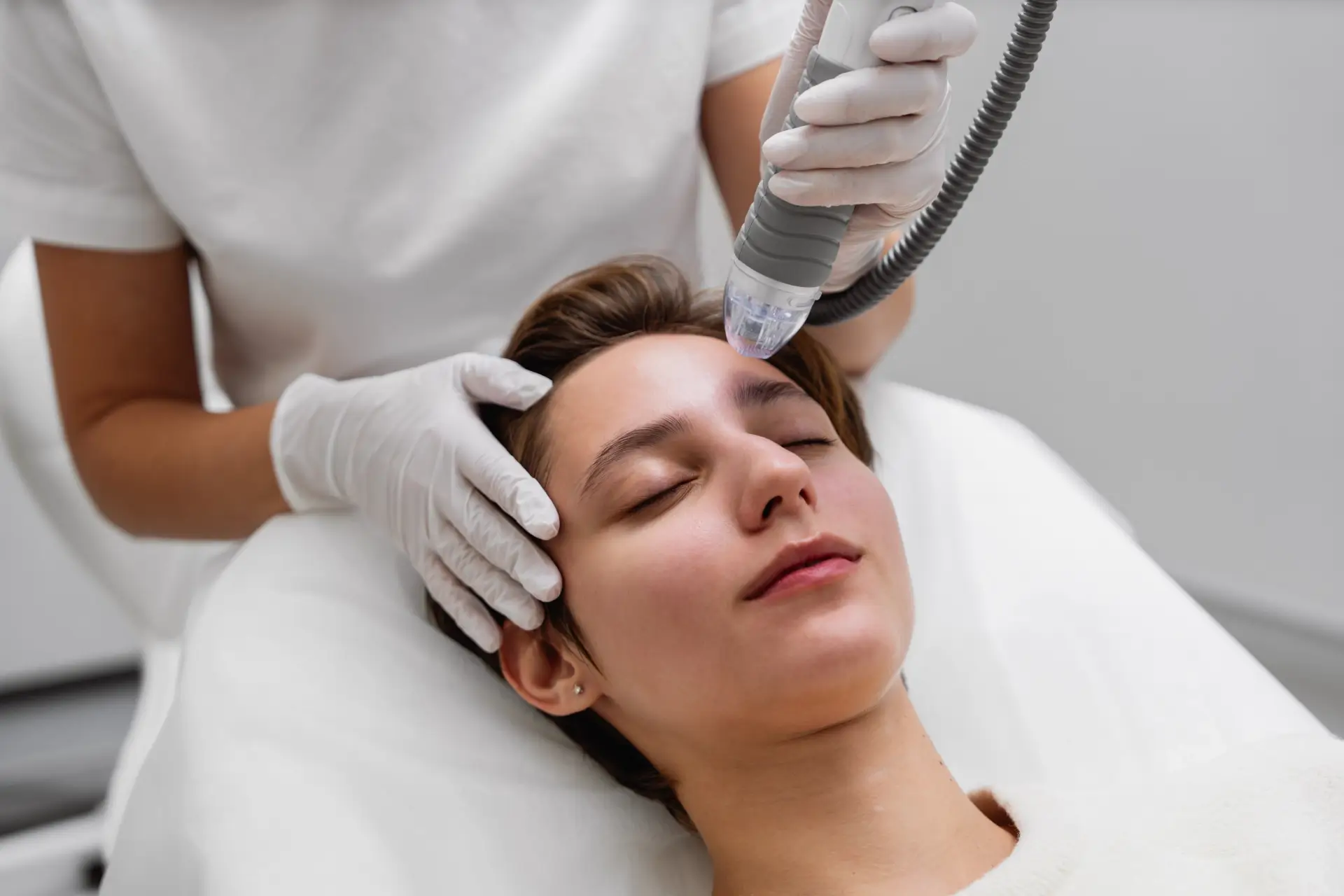
Fractional laser resurfacing works by delivering controlled micro-columns of laser energy into the skin, leaving the surrounding tissue untouched to speed healing. Each tiny injury triggers the body’s natural wound-healing response, prompting new collagen and elastin production in the treated area. Over the following weeks, that fresh collagen gradually fills in indented scars and smooths uneven texture, which is why results build gradually rather than appearing overnight. At Flawless Derma Centre, this is delivered using our SharpLight medical-grade platform, calibrated to your skin type and scar pattern. It tends to work best on rolling and shallow boxcar scars, where the surrounding skin can be coaxed to fill in; very deep ice pick or heavily pitted scars often respond more modestly and may benefit from a combination approach. Because collagen remodelling is a biological process and not an instant fix, most people need a series of sessions spaced weeks apart, with improvement continuing gradually for months after the final treatment. This pattern is consistent with published clinical reviews of fractional resurfacing for acne scarring (PubMed, British Journal of Dermatology).
Details of the fractional resurfacing service and its published pricing are on our pricing page — a personalized session plan is always confirmed at your consultation, never quoted higher afterward.
How many sessions will I need, and when will I see results?
There’s no single number that applies to everyone, since scar depth, type, and how your individual skin responds all factor in. In general, the process looks like this:
- Consultation. Priscila Ferreira, our certified SharpLight practitioner, or Dr. Harandi assesses your scarring pattern, skin type, and history, and confirms whether active acne needs to be addressed first.
- A series of sessions. Most treatment plans involve multiple sessions spaced roughly four to six weeks apart, allowing each round of collagen remodelling to progress before the next treatment.
- Gradual improvement. Texture continues to soften for months after each session as collagen matures, and many people reassess progress partway through their plan rather than committing to a fixed number upfront.
Patience matters here. Scarring formed over months or years of breakouts, and smoothing it is a gradual process, not a single appointment.
What does downtime and aftercare look like?
Fractional resurfacing is generally well tolerated, though downtime varies with treatment intensity and your skin. Most people notice some redness and mild swelling in the days afterward, similar to a moderate sunburn, with skin feeling tighter or slightly rough as it heals. Aftercare typically includes:
- Gentle, fragrance-free cleansing and a bland moisturizer while skin recovers
- Avoiding sun exposure and using broad-spectrum SPF daily, even on cloudy days
- Skipping exfoliants, retinoids, and active ingredients until your skin has fully settled
- Avoiding saunas, hot yoga, and heavy sweating for the first few days
We’ll walk you through exactly what to expect for your specific treatment intensity, since deeper settings mean more visible healing but often faster progress.
Why sun protection matters — and how Manitoba winters actually help
Healing skin is especially reactive to ultraviolet light; sun exposure during recovery can trigger new pigment changes or slow healing, which is part of why aftercare leans so heavily on SPF (MedlinePlus, U.S. National Library of Medicine). This is one area where Winnipeg’s climate works in your favour. Our long, lower-UV winters — from the shorter days of November through the still-cool stretch into March — make consistent sun avoidance genuinely easier during the healing window after a resurfacing session, compared to the intense summer sun many patio-season months bring. That’s part of why we see a steady stream of scarring consultations booked through the colder months from patients across River Heights, St. James, Tuxedo, and Wolseley. Treatment can still be planned responsibly in spring or summer with strict SPF habits — it just takes a bit more discipline to protect healing skin.
Getting started
If breakouts have left texture you’d like to improve, the first step is simply an honest conversation about what you’re seeing and what’s realistic for it. Book a consultation for fractional resurfacing or review our published pricing — Flawless Derma Centre has served Winnipeg since 2015 with medically guided care and no upselling, ever.
You can also see how this treatment works at our clinic on our acne treatment in Winnipeg page.